When it comes to intelligent, contextual cooperation with people in the workforce, we feel the term Cognitive Collaboration presents a clear picture of the relationship and the outcome. This is because the technologies involved allow for a significant element of cognition to be introduced to the collaborative user experience.
Cognition, in this case, means being capable of anticipating a user’s needs, employing reasoning, remembering outcomes, and taking proactive actions. Cognitive Collaboration brings together intelligence and context throughout all collaboration experiences. Bridging AI and ML capabilities with insight and the context of the meeting or customer interaction creates more meaningful experiences and outcomes. Cognitive Collaboration fosters human relationships, enhances customer interactions, and builds high-performance teams across boundaries, enabling smarter and faster decisions.
There are four pillars of technology that comprise the collaboration landscape:
Computer vision allows intelligent software to interpret its environment through room and personal device cameras. Resulting features include face, object, and gesture recognition. Combined with other technologies such as proximity pairing, computer vision provides powerful room interpretation to create better collaboration and meeting experiences for local and remote participants.
Cognitive Collaboration needs an advanced form of computing intelligence to operate.
Cognitive Collaboration brings together intelligence and analytics to deliver contextually relevant interactions across workflows. Intelligence is a combination of data and powerful analytics to deliver greater context. Data may be obtained from many relevant sources, including sensors, bots, enterprise applications such as CRM, Internet of Things (IoT) sensors, people profiles, insights into enterprise calendars and meeting resources, and even social data. When combined with analytics that identify patterns and relational clusters for individuals, teams, organizations, and customer insights, we are able to present the right information, to the right team, at the right time and place. This powerful combination delivers Cognitive Collaboration integrated into workflows for connected, relevant, and human experiences.
This is what brings the activities of collaboration out of a static era and into a fully dynamic one. The answer to this call is to integrate the many abilities of artificial intelligence and machine learning in ways that will create a working environment that is:
Cognitive Collaboration technologies offer solutions that could not have been achieved before with traditional techniques.
AI and ML are becoming catch-all terms that cover a wide swath of computing capacity and potential, and they are sometimes incorrectly used as labels to describe other technological advances such as graphics processing unit (GPU) power. For the purposes of this white paper, we are applying the terminology and abilities of AI and ML to solve for specific collaboration-related scenarios.
Artificial intelligence is often used as an umbrella term to cover various applications of machine learning. It is commonly applied to describe intelligent agents that take inputs from their environment and attempt to achieve a cognitive outcome as a human would. This requires a certain level of programming, training, or applied problem-solving to become practical.
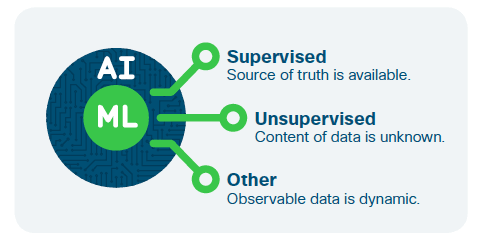
Machine learning allows computers to learn without specific programming. This is achieved primarily by learning from trained data models that are then used in conjunction with an algorithm to make predictions. Since ML uses sample inputs to predict an output, it is often referred to as supervised learning, given that the trained (supervised) model influences the output. Cognitive Collaboration fits within the supervised learning model.
Supervised learning generally starts with a large data set from which an algorithm is used to generate a prediction model (often called a trained model). The system identifies patterns in the data set that relate to different predictions. In the example of facial recognition, data set containing images of participants in a meeting as “known” (by name) or “unknown” can be used to predict the names of participants in future meetings.
For purposes of comparison and context within this paper, the two other models of machine learning are unsupervised and other variations.
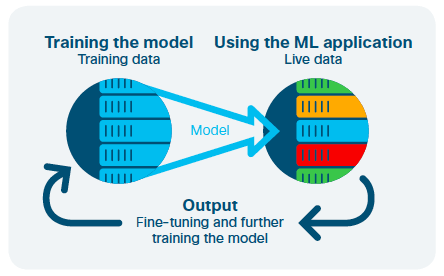
Machine learning software development is different from traditional software development techniques. Figure 2 shows in a supervised learning example how training data is used to create a trained model that is subsequently used with live data to predict an output.
Figure 2. Supervised learning example on the use of training data to predict output
Artificial intelligence, as we define it, stands to solve the productivity and collaboration challenges of this new age. But to do so, it needs to collect and process a great deal of information about how people work, communicate, and think. We have defined five phases of assisted AI that we expect deployments to go through. They are:
Simple command and control. An example includes asking the system to join a meeting or add someone to a call.
Natural language understanding. Understand the intent of the user with more complex queries like, “Give this action item to Pat to prepare the slides for next week’s meeting.”
Understanding specific terminologies and making sense of complex statements. Examples might include a verbal discussion about a current news story that triggers an automatic search and retrieval of that news story, along with related documentation. Or, after a meeting, AI helps summarize the key meeting topics.
AI starts to behave like a member of the team, taking action items and summarizing decisions.
In the future (within the next decade), an AI device acts as a strategic team member, making recommendations based on its business intelligence. For example, it might analyze sales results and recommend an increase in sales headcount in a specific region to grow revenue.
To support all these phases, AI services need to collect and process business-related data and context. When it can do this, AI allows more time for employees to engage in high-value tasks, more creativity from participants, increased satisfaction with work (leading to higher retention levels and ROI on onboarding and training), and stronger team commitment, to name a few advantages.
In the context of Cisco Webex® Assistant, Cisco is currently between phases 2 and 3, although some user adoption rates might trail this. Getting to phases 4 and 5 will require more integration with customers’ data. The earlier phases use supervised machine learning, which can be built using internal data—no customer data is required. Moving into these latter phases will be a highly significant transition, and the techniques used must always be designed with specific customers in mind.
Cisco brings market-proven AI and ML capabilities to the collaboration platform. As Figure 3 demonstrates, we were an early innovator in this field, and we continue to build on our background in machine intelligence as we develop and acquire new solutions that together deliver a complete package.
Together, this history of collaboration innovation and acquisition reduces dependencies on third-party services and allows for enterprise-centric designs of both cognitive services and endpoint devices that share a common DNA.
Figure 3. Cisco AI capabilities in collaboration
Looking more closely inside, Cisco’s Cognitive Collaboration endpoint features are enabled by the NVIDIA platform—delivering the compute intelligence that works with extreme camera technology and machine learning for a variety of real-time situations. For context, using an outside (non-Cisco) example, in a car, a seamless 360-degree view is helpful for passing slower cars, changing lanes safely, and self-parking. It also incorporates machine learning capabilities for sensing and classifying objects. This same technology enables Cisco Cognitive Collaboration solutions with the compute power to:
The Cisco engineering team has developed proprietary algorithms and processes that leverage the underlying GPU-based hardware to help ensure that the identification of faces and the understanding of speech remain accurate and secure. This is one of the ways that the process differs from other competing forms of signal analysis. Rather than simply cross-referencing data stored in the cloud, Cisco supports full security and privacy by incorporating and encrypting tokens that render data in transit worthless to bad actors.
1. https://www.bcstrategies.com/content/bridges-and-clouds-cisco-collaboration-analyst-summit-2019