In my 25-year networking career working directly with customers, I’ve become accustomed to network teams traditionally splitting into separate domains. Larger networks are very often built and operated based on distinct domains, like campus and branch, data center and WAN.
It was sometimes eye-opening for me and even a little awkward when I had the opportunity to introduce members of different domain teams to each other. Oftentimes they were simply working in isolated silos. And that has become a major obstacle to IT and the business.
As we are rapidly learning, network agility is a fundamental requirement to meet the dynamic needs of your digital transformation initiatives – and increase your business resilience needs as well. And that agility cannot be served by a single domain alone. It needs to be end-to-end — from the user or device to wherever the application is located.
Time and again, I have witnessed this legacy approach to networking foster a manual operations environment, inefficient deployment procedures, slow troubleshooting and a tactical, inconsistent approach to planning.
Easier said than done. That shift needs to be done in digestible stages. I’ve always been a proponent of a crawl, walk, run approach – so long as you keep your ultimate goal in sight. In this case, that means building the intelligent automation and insights delivered by an intent-based networking (IBN) platform in the individual domains. Each is dedicated to the very specific needs of that domain. For example:
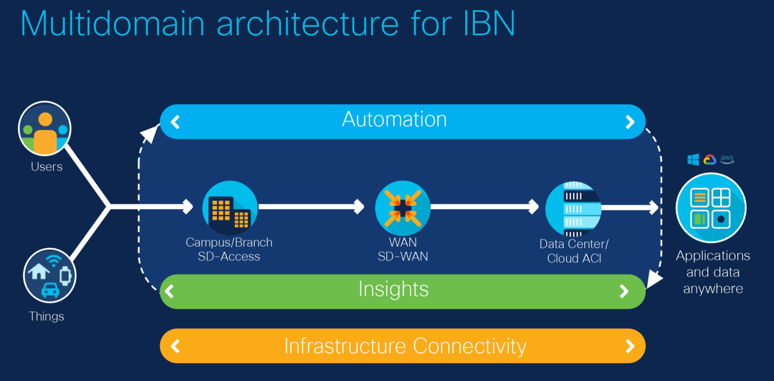
Multidomain architecture for IBN.
Creating separate domains allow each to focus on the unique job at hand. It is analogous to the move from monolithic applications to containers, in that it takes large tasks and breaks them down into smaller more manageable services, and allows them to focus on specific functions. But when integrated together, they operate as a single larger application. With one or more of these IBN domain platforms in place and by taking advantage of the built-in API’s, you have the opportunity to deliver on a multidomain IBN strategy that aligns the network to application and security policy, end-to-end.
Multidomain for IBN video
Moving towards a multidomain architecture will not only ease the demands on your IT team but will deliver a better end-user experience. Your journey to multidomain for IBN does not mean you need to incorporate all three domains to enjoy the benefits of automation, visibility, and insights. You can start simple and implement a single domain which best fulfils your business requirements.
Many ways to multidomain IBN.
Source: blogs.cisco.com